Understanding how search architecture works behind the scenes is essential for building sustainable organic reach. Optimization is no longer just about 10 blue links on a Search Engine Results Page (SERP).
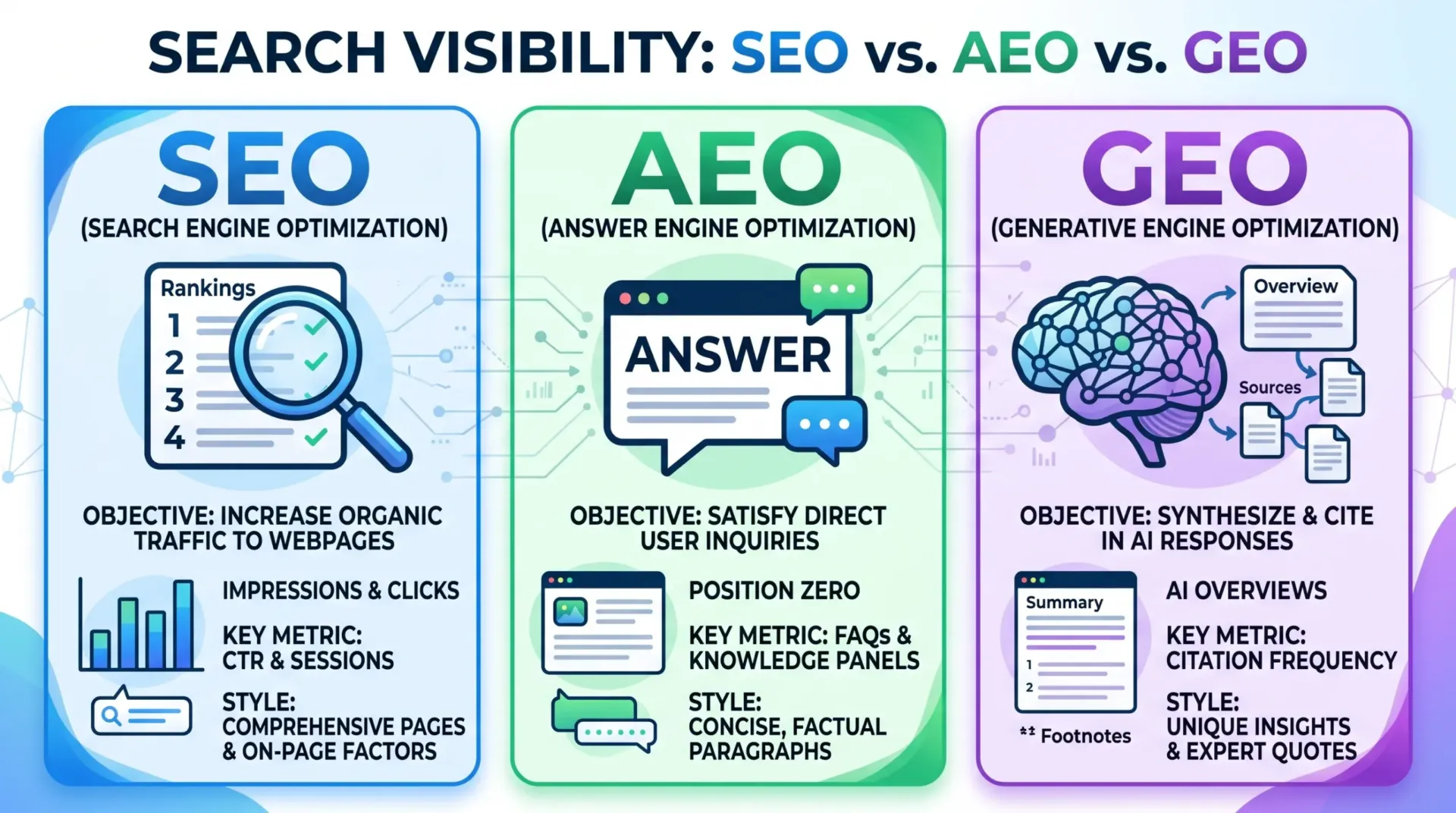
Search has expanded into three distinct disciplines: Search Engine Optimization (SEO), Answer Engine Optimization (AEO), and Generative Engine Optimization (GEO).
While they share a foundation built on high-quality information, their mechanics, retrieval pipelines, and key performance indicators operate differently.
Core Definitions
- SEO (Search Engine Optimization): The process of optimizing web pages to rank in traditional search engine indices (such as Google or Bing) to drive organic click-through traffic.
- AEO (Answer Engine Optimization): The practice of structuring information so search algorithms can directly extract concise, factual answers for Featured Snippets, Knowledge Panels, voice assistants, and zero-click queries.
- GEO (Generative Engine Optimization): The strategy of optimizing content authority, brand entity relationships, and informational depth so Large Language Models (LLMs) like Google Gemini, ChatGPT, and Perplexity synthesize and cite your brand in multi-source generative responses.
High-Level Comparison: SEO vs. AEO vs. GEO
| Dimension | SEO (Search Engine Optimization) | AEO (Answer Engine Optimization) | GEO (Generative Engine Optimization) |
| Primary Target | Traditional SERP rankings (10 blue links) | Position Zero, Knowledge Cards, Voice Search | AI Overviews, LLM chat summaries, synthesis engines |
| User Intent Match | Broad discovery, navigation, transactional research | Direct informational (“What is”, “How much”, “When”) | Multi-step reasoning, comparative analysis, contextual queries |
| Content Structure | Comprehensive pages, headers (H2/H3), topic clusters | Concise 40–60 word answer targets, lists, direct tables | Data-backed paragraphs, original insights, quote-dense text |
| Key Metrics | Impressions, Organic CTR, Keyword Rank, Organic Sessions | SERP Feature Ownership, Zero-Click Share, Voice Impressions | Share of Model (SoM), Citation Frequency, AI Mention Sentiment |
| Technical Core | Crawl budget, indexation, internal linking, Core Web Vitals | Schema markup (FAQPage, HowTo), semantic HTML | Knowledge Graph alignment, entity disambiguation, citations |
1. Traditional SEO: The Architectural Foundation
SEO focuses on indexation and ranking algorithms. Search engines crawl the web via spiders, parse Document Object Models (DOM), index textual/visual assets, and rank documents based on relevance signals, domain history, and technical performance.
Google Quality Guidance:
“Our ranking systems are designed to present helpful, reliable information that’s created for people, not to gain search engine rankings.” — Google Search Central
Key Strategic Pillars:
- Information Architecture: Clear URL hierarchies and structured internal linking.
- On-Page Optimization: Title tags, headers, descriptive anchor text, and comprehensive search intent matching.
- Off-Page Authority: Editorial backlinks and domain trust metrics.
2. AEO: Direct Extraction & Answer Delivery
AEO is built for information extraction. Answer engines do not synthesize multiple concepts from scratch; instead, they pinpoint the single most direct, accurate paragraph or list from a crawlable source to satisfy user intent without friction.
Empirical Impact:
- Zero-Click Behavior: More than 55% of mobile search queries result in zero clicks because direct answers or featured snippets fulfill the user’s intent immediately on the SERP.
- Extraction Timing: According to search query analyses, answer engines favor direct responses placed within the first 50–70 words under an explicit heading query.
Optimization Techniques for AEO:
- The Inverted Pyramid: Place the direct definition or answer immediately below the H2/H3 before diving into background context.
- Schema.org Implementation: Leverage structured data (Dataset, Itemlist, FAQPage) to make programmatic extraction unambiguous for bots.
- Conversational Question Phrasing: Match natural long-tail voice inputs (e.g., “What is the standard turnaround time for…”).
3. GEO: Synthesis, Citation, and Entity Authority
GEO addresses how Large Language Models generate text. When AI models construct an answer using Retrieval-Augmented Generation (RAG), they select authoritative chunks from across their training data and indexed web pages to summarize conclusions.
Traditional SEO Pipeline: Query -> Index Lookup -> Ranked Links
Generative AI Pipeline: Prompt -> Vector Retrieval -> RAG Synthesis -> Cited Summary
What Drives AI Citations:
- The Princeton GEO Study (KDD): Found that adding authoritative statistics and hard numbers increases generative visibility by up to 40%, while including direct expert quotations and factual citations improves citation frequency by 41%.
- Information Gain: LLMs filter out redundant content. Having first-party survey data, proprietary case studies, or unique benchmark testing makes a page citable over generic rewrites.
Aligning with Google’s E-E-A-T Framework
To perform across SEO, AEO, and GEO, content must satisfy Google’s Experience, Expertise, Authoritativeness, and Trustworthiness (E-E-A-T) guidelines:
- Experience: Demonstrate first-hand application (e.g., screenshots, original workflow data, or test logs).
- Expertise: Content must show technical accuracy, precise terminology, and clear attribution to qualified authors.
- Authoritativeness: Cultivate citations, digital PR mentions, and consistent entity profiles across external sources.
- Trustworthiness: Provide transparent sourcing, verifiable claims, and secure, accessible site infrastructure.
Frequently Asked Questions (FAQs)
Does GEO replace traditional SEO?
No. Generative engines use search retrieval systems to find real-time sources. If a site lacks technical crawlability and indexation (the core of SEO), generative models cannot find it to cite it.
How do you measure GEO success?
GEO is tracked using “Share of Model” (how frequently an AI mentions your brand when prompted for category recommendations), citation link rates inside AI Overviews, and referral traffic originating from generative interfaces.
Can a single page optimize for SEO, AEO, and GEO at the same time?
Yes. An article can earn traditional rankings (SEO), contain structured definition boxes that capture featured snippets (AEO), and provide unique empirical data that LLMs reference in synthesized summaries (GEO).